Towards an Understanding of the Public’s Attitudes and
Preferences for Protecting Steller Sea Lions
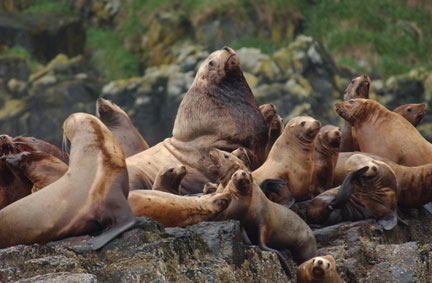
STELLER SEA LIONS (Eumetopias jubatus) live in the North
Pacific Ocean and consist of two distinct populations, the western
stock and eastern stock, which are geographically separated at longitude 144° W. As a result of large declines in the populations since at
least the early 1970s, the Steller sea lion was listed as
threatened throughout its range under the U.S. Endangered Species
Act in April 1990. The decline continued through the 1990s for the
western stock in Alaska, which was declared endangered in 1997,
while the eastern stock remained listed as threatened.
A mail-based stated preference survey was developed by members of
the Alaska Fisheries Science Center’s (AFSC) Economics and Social Science Research Program and collaborators at the University of
Washington and Stratus Consulting, from Boulder, Colorado. The
purpose of the survey was to collect information on attitudes toward
threatened and endangered species and Steller sea lions, and
preferences for protecting Steller sea lions that can be used to
estimate the public benefits of providing additional protection to
Steller sea lions, above and beyond current protection measures.
Additionally, the collected information is intended to shed light
on public attitudes toward threatened and endangered species in
general and Steller sea lions in particular. The survey was
developed and carefully tested with the aid of a series of focus
groups and cognitive interviews held in cities across the United
States including Alaska. The survey also incorporated input from
several Steller sea lion biologists and experts in stated preference
techniques and survey design and methodologies.
This research may be useful to resource managers as it provides
economic benefit information for a species whose protection and
management affects other species and industries and, thus, has large
economic consequences. The economic costs of protecting the species
are generally estimable and, thus, more easily incorporated in
policy discussions. Still, this research has shown the benefits of
alternative management actions that affect a public resource like
the Steller sea lion can be quantified as well using carefully
constructed and implemented stated preference survey methods. Read
the complete article (PDF ; 1.2 MB)
|