
Insights From a 12-Year Biophysical Time Series of Juvenile
Pacific Salmon in Southeast Alaska: the Southeast Alaska Coastal
Monitoring Project (SECM)
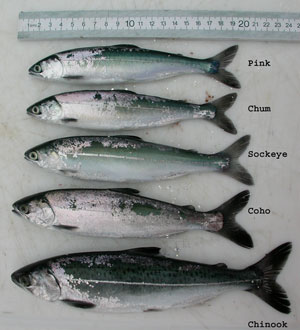 |
The five salmon species found in
Southeast Alaska. Photo by Joe Orsi.
|
PACIFIC SALMON (Oncorhynchus spp.) occur throughout
Alaska waters and have important linkages among freshwater,
estuarine, and oceanic ecosystems. Although salmon in Alaska waters
are primarily managed by the state of Alaska, the National Oceanic
and Atmospheric Administration (NOAA)’s 2006-2011 Strategic Plan
addresses many issues related to salmon, such as their marine
essential fish habitat, the migration of endangered stocks, the
interactions of wild and hatchery stocks with respect to ocean
carrying capacity, and the ecological interactions of salmonids with
other species within the context of climate change.
Since 1997, the Alaska Fisheries Science Center’s (AFSC) Auke Bay
Laboratories have maintained a study, the
Southeast Alaska Coastal Monitoring (SECM) project, to develop
time series of the biophysical data associated with juvenile salmon
and their coastal ocean environment within Southeast Alaska and into
the Gulf of Alaska. This time series enables ecosystem change to be
measured and compared to variability in juvenile salmon dynamics and
their subsequent year-class strength. This article describes the
SECM research approach and presents key findings from this 12-year
effort.
Read
the complete article (PDF ; 773 KB)
| 