
Research Feature: FMA Division Redesigns Observer
Sampling
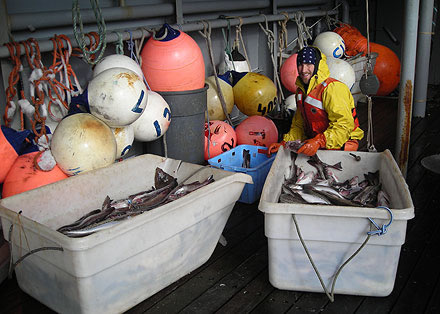 |
| North Pacific groundfish observer Steve
Rideout collects multiple samples aboard a Bering Sea pollock
catcher vessel using the FMA Division's improved sampling
protocols. Photo by FMA Division. |
The Fisheries Monitoring and Analysis Division (FMA) monitors
groundfish fishing activities in the U.S. Exclusive Economic Zone
off Alaska and conducts research associated with sampling commercial fishery catches, estimation of catch and bycatch mortality, and analysis of fishery-dependent data. The goal of the Division is to provide high quality commercial fishery data to other programs to be used in fisheries management, stock assessment, and research efforts. Much of this goal is accomplished by the
Division’s North Pacific Groundfish Observer Program (NPGOP), which deploys over 400 individual observers to vessels and processing
facilities in the North Pacific.
Fishery-dependent data demands change with time, and each year
the NPGOP receives requests to modify or add data elements. In
January 2008, FMA implemented several long-awaited sampling and
database changes that had been recommended in various independent
reviews as well as by in-house staff. These changes fundamentally
altered the way observers collect and record their data.
Modifications were made to both the methods used to collect data at
sea and to the Alaska Fisheries Science Center (AFSC) database that
houses the observer data.
One of the most substantive changes is that observers are now
asked to collect and individually record at least three samples for
species composition from each sampled haul or fishing event.
Previously, samples were pooled together. These changes allow NMFS
to better understand the statistical properties of the data and the
estimates derived from that data. In particular, we are now
capturing the data in a way that allows us to assess within-haul
variance.
Read
the complete article (PDF ; 700 KB) | 